Sunday, 30 April 2017

2017 Greek Wine Tasting, London

Still fresh from the Grand Portuguese tasting I had the Greek equivalent to deal with earlier this week, which took place at Vintners Hall. The event was reasonably well supported by importers and
producers and appeared to be busy, though it was difficult to know how many of the visitors were buyers, and the wines on show were a good, representative mixture of what is happening on the Greek wine scene at the moment. The organisation was fine and the event ran smoothly, if you exclude the nibbles section; this was meant to be a bit of Greek cheese with bread and/or biscuits, but these ran out very early on, so staff were reduced to rushing around to the local supermarket for edam, crackers and basic baguette. The current impecunious condition of the Greek State explains some of this, the lack of planning ahead typical of modern Greece the rest. Still, overall I feel that the tasting was a success, which may or may not be reflected in the UK marketplace with a sale surge, thanks to the efforts of the small group of specialist importers promoting Greek wine. And against all the efforts of the Greek government, who are making wine exporters life more difficult instead of easier, by introducing petty short-sighted regulations rather than blessing and supporting any decent export activity.

I cannot understand the thinking behind Greek politicians and bureaucrats, small-minded, short-termist and petty, and against the very people (exporters) who can help the cash-strapped country earn some valuable foreign currency. But no, why bother with creative economic activity when we can reduce pensions further and tax property owners until the pips squeak, despite the fact that these tactics have not worked and are
destructive, driving what's left of the productive economy into the ground. This is sad and unnecessary, stupid even, but producers at the tasting put on a brave face and did their best for their products, and their country.

Greek wine has never had a huge market in the UK, despite their being quite a few greek restaurants all over the place. In the past this was certainly, at least partly, down to the mediocre quality of the mainstream wines available, but in the last 30 years there has been a huge change in the picture, with the old, once dominant, large companies playing second fiddle to adventurous independent estates with young winemakers bursting with new ideas. The leap in quality, mirrored in other traditional wine-making countries (Portugal, for example...), has been impressive, with Greek varieties being rediscovered or reworked in more modern or better ways, and international varieties also growing and glowing. The wines are good enough in quality terms to compete now, their standards of presentation also; some are even stars by international standards. Why are they not taking the market by storm?

There are several current reasons for this, such as:
1. Past impressions/past reputation.
2. Retsina (real or imagined experience of poor examples thereof).
3. Little proper support from the Greek state, ever - compare to Spain (for example) and others.
4. Relatively high prices.
5. Most tourists tend to drink 'house' wines, which are poor or indifferent, but cheap.
6. Lack of focus/understanding of the international market by producers.

Still, with things much better in quality terms, I chose a selection of wines to taste, some familiar, others new to me. Overall I was impressed by the standards on show, but let me be a bit more specific about the main points.

The now established stars in international terms are the white wines of Santorini, the small volcanic island at the southern end of the Cyclades, with the stunning scenery and sunset. Produced in the most inhospitable landscape and threatened by property development, they are now acknowledged to be individual and generally of exceptional quality, with a unique taste. Having tasted most of the wines on show I found them all to be impressive, but my personal choice on the day would be the Argyros range, which to me showed more freshness, and were perfectly balanced. Not one of the wines I tasted was disappointing or poor, but they are now with prices to match - no more bargains from Santorini, I'm afraid! Most everyone said that the 2016 vintage is near perfect for the Santorini white wines, so it will soon be time to try and buy...

The other star from Santorini is, of course, its sweet wine (Vinsanto); at its best it is a match for any sweet wine from anywhere in the world. Whilst I liked the examples on show I was not entirely bowled over, or not as impressed as I had expected to be - was I expecting too much?


One of the wines that in my opinion is deservedly on its way to the top is the humble Savatiano, which is traditionally grown in Attica, near Athens, long pooh-poohed and used in the past mainly to make Retsina. The variety, properly utilised, produces a subtle wine that can be complex and beguiling, with a slightly aromatic nose. In the past it was thought to lack character but that is wrong, though badly made examples are boring, and was mixed with more flowery varieties to mutual detriment. These days are nearly at an end, so be prepared for some impressive single variety Savatiano wines to be the new stars from Greece. Unfortunately there is a downside, as this most reasonably priced of wines is becoming more expensive by the minute.

In theory Greece, with its mainly hot climate, should be great for big red wines, and there is a bit of a tendency to make these. What a lot of people ignore, though, is that bits of northern Greece get very cold winters and fairly mild summers, producing more complex, delicate reds like in the Naoussa region with its Xynomavro (sour black) grape variety, somewhat reminiscent of Burgundy Pinot Noir styles. Winemakers in other areas with individual microclimates are also making more complex, less aggressively big red wines, to the benefit of those of us who favour subtlety over obviousness.

So in conclusion, Greek wine put on a good show in these difficult times as far as this tasting is concerned. As far as the marketplace goes, there is a lot more work to be done, at least in the U.K., though things are moving in the right direction. If only this effort by the long-suffering importers, the producers, even the potential buyers was somewhat supported by Greece itself.

I have lots of individual opinions and detailed notes which will follow in the next week or so as a separate piece to make life easier for my myriads of readers.

Monday, 24 April 2017

Lunch, Dinner, Lunch

Thirty years is an awfully long time to have known somebody, yet I have known my friend James for that long; we met through the wine trade and became friends along the way. We've kept in touch over the years, done a little bit of business and had the occasional super lunch (with plenty of lubrication, thank you!). It's always a pleasure to see him, whatever the circumstances, and we seem to manage to get together every few months for a catch-up.

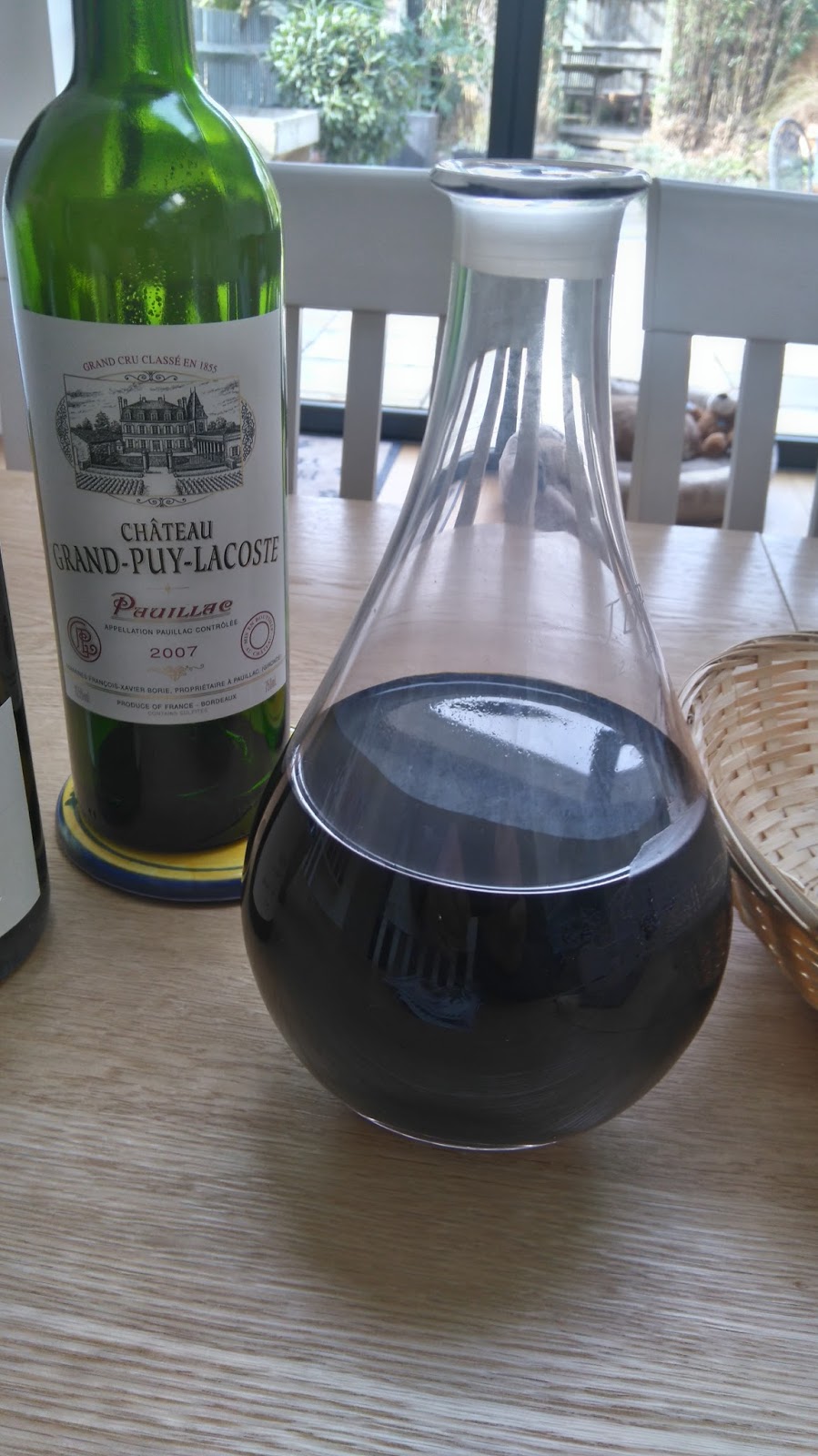
This is precisely what we did when I visited him at his home/office in south London for a chat, a spot of lunch and a glass or two of wine to lubricate the throat and aid the digestion. The lunch was tasty and simple - bit of salad and prawns as a starter, a nicely grilled piece of meat, veg and potatoes as a main course - but the wine was not. We kicked off with a superb Sancerre 2015 (Terre de Maimbray, Pascal et Nicolas Reverdy), subtle, rich and complex Sauvignon Blanc at its best, a far cry from the screaming obviousness of New Zealand examples, so enjoyable! This we made short work of, so James was forced to bring out reinforcements in the shape of a lovely Roero Arneis 2015 just to get us through the prawny bits, and very nice it was too, as difficult as it was to follow that Sancerre. Then we had some claret from a difficult vintage (Grand Puy Lacoste 2007), and I was amazed and impressed - it was a textbook example of fine red Bordeaux wine, modern with everything in the right place and balanced, juicy and luscious, not over the top, a very classy wine.
This, together with our catching up, was the high point of this simple, excellent lunch, and of an afternoon memorable for its subtle quality and real amity. Unfortunately I had to rush off to a meeting late in the afternoon miles away in Kilburn and so bring this extremely pleasant visit to a premature end. Ah, to leave such a relaxed, convivial meeting in order for me to scurry across London, on and off trains like a madman, terribly sad but pre-arranged and necessary - no sudden illness for me there!  And, in case you're wondering, I did get some funny looks when I arrived for my meeting, red-faced and smelling like a winery, though nothing much was said at the time; raised eyebrows said it all.

Every two or three months I meet up with a couple of friends (A and D, to preserve their anonymity) for dinner at selected restaurants. The restaurants are selected only if they allow BYO (bring your own wine), are reasonably priced and serve interesting food; so far we have eaten in various mainly small, independent places, and on a Friday evening late in March we did just that. Both A and D have decent wine cellars, so bring interesting bottles, while impecunious little I bring whatever I can scrounge or the odd half-bottle of sweet wine, something inexpensive but good, if possible.

This time we arranged to meet at a Persian restaurant in Olympia called Mohsen, a few blocks north of Earls Court tube station, a simple place with tasty food but no pretensions or at least none that were apparent to me. There is a tandoor oven by the entrance and their bread, like most similar establishments, are freshly made and delicious. The Persian restaurants that I have tried also have another strength, and that is their ability to have their grilled meat remain succulent and juicy, though this is slightly negated in my eyes by their insistence on serving lots of rice with everything. Their rice is fragrant and nicely cooked, but a bit boring; let's face it, its real use is when you have dishes
with nice rich sauces, as in Indian cuisine, and rice is their to collect and solidify... What can I say, I'm a potato man, especially with grilled meat, and lots of vegetables thrown in for good measure...
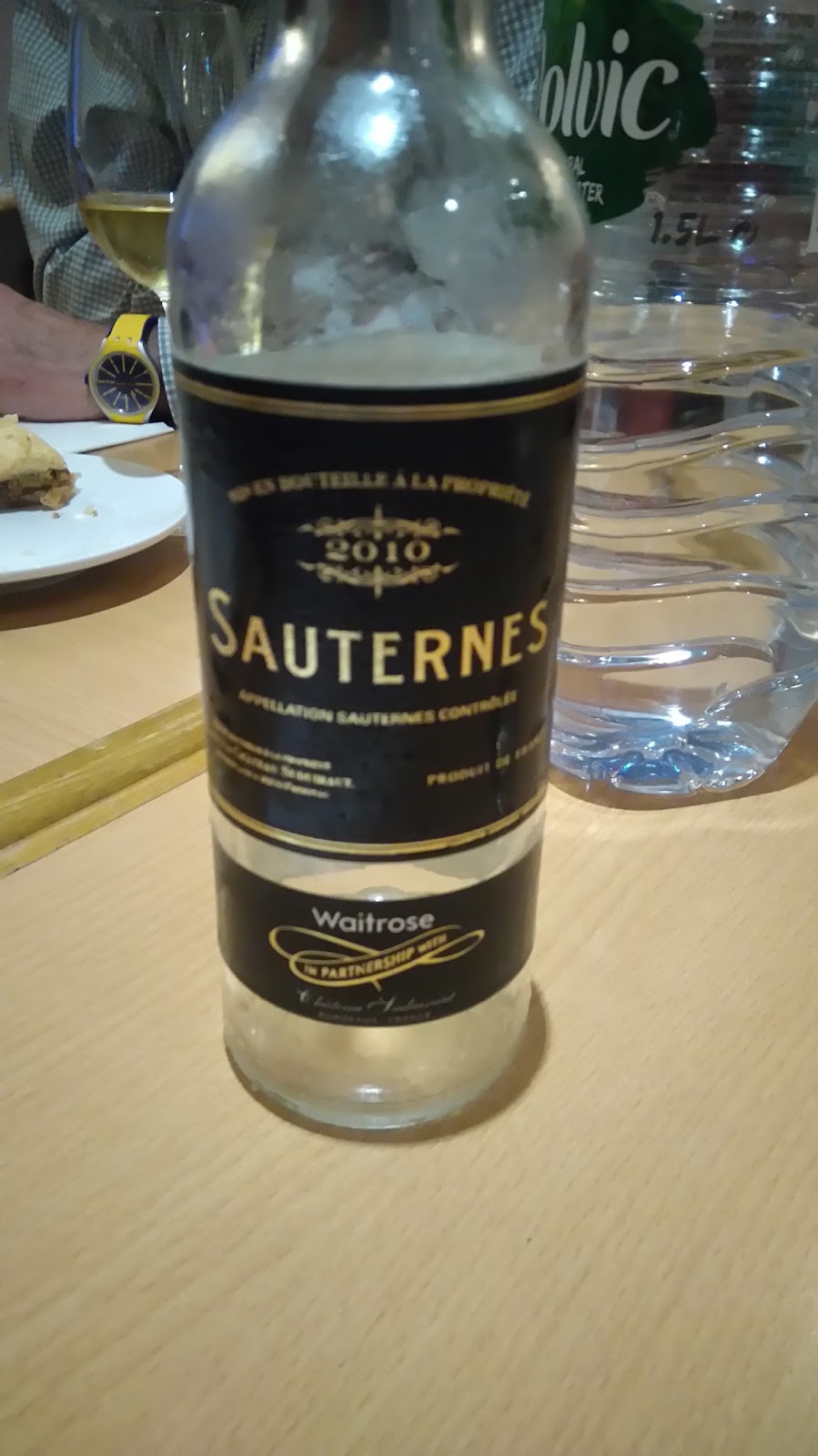
The food on the night was pleasant and tasty, if unremarkable, the bread yummy! My friends having raided their cellars came up with several red wines, one of which was a rare Moldovan red of considerable age, alas not in good shape; we ended up with a perfectly decent, balanced Chateau Haut-Marbuzet 1995 from St. Estephe, Bordeaux, past its best but drinking nicely though fading, and a voluptuous, spicy Saint Joseph Offerus 2008 from Chave, perhaps more suited to the style of food than the claret. We ordered a tiny bit of dessert to cleanse the palate, with the little syrupy pastries being pleasant but the ice cream indifferent, and had my wine (1/2 bottle of Waitrose finest Sauternes 2010) which was delightful, fine Sauternes from a good vintage at a very reasonable price! And fine Sauternes is great stuff, luscious and complex, full of ripe white fruit, honeyed and complex, long and compelling, a lovely mouthful always worth tasting. Needless to say that we wandered off down to the tube station in fine spirits, replete with good wine, decent food, good conversation and looking forward to the next time.

The last interesting meal I had was a few days ago, when I met my friend Lance for a quiet lunch - and a long overdue catch-up - at a restaurant he supplies in Soho called Vinoteca, part of a small chain with simple, tasty food and interesting wines. We both had sherry as an aperitif, and mine was a delicious Amontillado, nutty brown in colour, nose and palate (toasted hazelnut?), bone dry with a whiff of richness, complex and long. We then shared a young Chorey-les-Beaune red Burgundy from the 2015 vintage, which was all you would expect: vibrant red fruit, soft and juicy, clean and relatively simple to drink, but satisfying. Burgundy is my favourite wine producing region and at its best produces incomparably majestic red and white wines, complex masterpieces to be savoured when you come across them. It is not an easy area to buy wine from, and fine examples often come with eye-watering price tags, but good advice (trust your wine merchant!) will eventually pay dividends, as will buying relatively early. Of course I cannot afford to buy any fine Burgundy at present, nor any other fine wine, but hopefully this may change in the near future - until then I will continue to rely on my friends and their kindness and generosity.

 All good things come to an end, and both Lance and I had to hurry off to do other things after an invigorating cup of coffee; Lance to a meeting, hopefully to sell more wine, I to write up my adventures, in wine and otherwise, for my discerning if currently limited public!

Tuesday, 18 April 2017

More Grand Portuguese Tasting

If you've read the first bit, you'll know that I was doing a bit of name-dropping at the same time as talking about the wines concerned - if you haven't, what were you thinking of, dear me, go back and ingest. Those who know me well will realise that the name dropping was only necessary because the people mentioned are important to wine in one way or another and not because of my ego. So there's more of it to come... read on!

Walking around and looking at some of the wines on show, I was transported back to the days when we first started working with Portuguese wines and were the new kids on the block, with unusual offerings, naivety and enthusiasm. Some of the properties we used to represent or had discussed representing were at this Grand Tasting, including one of the estates we had had a bit of success with, now in the hands of new owners after falling from grace and into the clutches of the banks. Before you ask, of course it's tempting to go back into this world, with its good people and wonderful products; were I not impecunious I would seriously consider it, for the sheer pleasure of the wine business. But I am without serious funds and it is not an easy market to be profitable in, so for now it must remain a favourite subject for discussion, appreciation, criticism but, above all, enjoyment.

One thing I was able to do at the tasting, at least partly, was to rectify the injustice that I inflicted on Domingos Alves de Sousa when tasting his wine as mentioned in my February 11, 2017 post (I have yet to write properly about them, despite promising to do so... apologies, will rectify soon); the wines were being shown here by his daughter and I was able to finally taste their ports and re-taste a couple of their big reds - and to tell her how much I'd appreciated meeting her father earlier in the year.

Richard Mayson wrote probably the definitive book on Portuguese Wine in the 1990s (Portugal's Wines and Winemakers), a carefully researched labour of love, helped partly by his good command of the portuguese language and partly by his sheer enthusiasm for his subject. I have known Richard since he used to work at the Wine Society as a buyer many moons ago when I was trying to interest them in buying my wines, alas unsuccessfully. Richard has now, despite finding the time to write several other books and articles on wine, expanded his activities to owning a Quinta in the Alto Alentejo area and, together with winemaker Rui Reguinga, producing and marketing wine and he was here, charming as ever and proudly showing his babies to the world. Their new white wine Pedra Basta white was full and round on nose and palate, the Duas Pedras 2013 red was all soft roses on nose and palate, gluggable, the Pedra Basta 2013 more serious, deep purple colour, ripe red fruit on nose, creamy, juicy red berry fruit on palate, bit of tannin. More serious still are the Pedra Basta Parcela Granito 2014 (95% Syrah, 5% Viognier), purple, young, raspberry & cream on nose, woody fruit on palate (overoaked or just needs time?) and the Pedra e Alma 2011 with its deep colour, damson nose, slightly hot, spicy, tannic palate and a long
but hard finish, needing perhaps a bit more time.

Vinho Verde is one of Portugal's great glories at the top end of the scale, complex and alluring, at times flowery and approachable, at times steely and austere, always bone dry. Proper Vinho Verde has never been particularly easy to sell because of the easy drinking cheap stuff marketed under the same appellation by the big companies, sweet and spritzy, and very cheap; this is a great pity, as the real stuff is delightful, serious and hugely enjoyable. I tasted a few but was not massively impressed by much, other than the prices asked, which in some cases suggested a retail price level of over £20 on the shelf in the UK, at which level there is an immense amount of choice. Perhaps their market in Portugal will accept these prices, but elsewhere they surely cannot compete. Am I missing something here, I wonder.

Julio Bastos is the owner of a spectacularly beautiful Quinta in the Alentejo, and he makes some excellent wines there. We worked together briefly when he used the trademark 'Quinta do Carmo' for his wines, long since sold (to the Lafitte Rothschilds, I believe), but in the year 2000 he started Dona Maria wines and he was showing these, varying from straightforward everyday white/rose/red to serious big reds that the estate is most famous for. The everyday Dona Maria White 2015/Rose 2016/Red 2014 were all well-made, easy-drinking in style, surely commercially successful, at least in Portugal. A step up were the Dona Maria Amantis Reserva 2014 white, a powerful yet delicate white from Viognier, and 2012 red with a good, deep colour, sweet red berry nose, balanced palate with a long-ish finish. The Dona Maria 2013 varietals (Touriga Nacional & Petit Verdot) were awkward, with the TN a bit  bland and the PV chunky and woody on the palate, after a delicate creamy nose promised more. The Dona Maria Grande Reserva 2011 was a biggy, deep and purple with hardly any edges, a creamy plum nose and palate, long but a bit hard, perhaps lacking the sheer balance and elegance of the Quinta do Carmo 1985 as I remember it. Or perhaps it is still in its infancy?

Quinta do Casal Monteiro is another property we used to represent, when it was under the ownership of the Margaride's family and at the forefront of Ribatejo (now Tejo) winemaking. The estate was at the time beautifully laid out and organised, with no point more than 10 minutes drive from the winery, important to protect the quality of the fruit in such a hot area. Sometime after we ceased our activity - and so lost touch - the family hit hard times; the current owners bought the estate from the bank and are busy reinvigorating it. I tasted two of their white wines, both 2016s, one a blend of Arinto and Fernao Pires which I found fresh, slightly medicinal, herby and longish, the other a blend of Arinto and Chardonnay which had a delicate nose, a rather chunky mouth redolent of pears and with a long aftertaste. Neither were spectacular, but both were decent, well priced and have potential. Arinto, incidentally, is a grape variety that in my opinion can make excellent wines of unique character, but needs to be handled with care.

Clark Foyster wines import an assortment of interesting wines from different places, including Portugal, and it is run by my friend Lance Foyster MW, whose love and understanding of wine is second to none. Lance seeks out good,
individual producers who love what they do, go the extra mile but also have commercial potential - wine merchant cannot live on love alone! I tasted some of his wines, well, quite a few actually, starting with a Vinho Verde 2015 Deu La Deu Alvarinho (a grape variety much in fashion, especially the Spanish version - Albarino - and considered by many, but not necessarily by me, the best for Vinho Verde), which had a delicate, distinguished Alvarinho nose, but was a bit hard on the palate, long if slightly bitter finish, a food wine from the cooperative at Moncao. Next was another Vinho Verde from Anselmo Mendes, a Muros Antigos Loureiro 2016, restrained on the nose but exuberant on the palate, big, beautiful and long. The Muros Antigos Alvarinho 2016 had the typical Alvarinho nose , harder on palate with a long finish; much better, to my mind, was the Contacto 2016 Vinho Verde Alvarinho which was softer, finer, more distinguished and complex, in every way a star. I was also quite take by a Dao white - Ribeiro Santo Automatico 2016 - with delicate fruit on nose and palate, clean and fresh, very dry but delicately complex and long. Red Douro wines from Quinta das Tecedeiras came next, Flor das Tecedeiras 2014 having a deep colour and being floral, light and clean, while the Quinta das Tecedeiras 2014 Reserva showed a very deep ruby colour, a refined raisiny nose, ripe strawberry on palate, spicy, tannic, long. Even better was the Boa Vista Douro 2013 Reserva with a deep colour, ripe red fruit and oak on the nose (it spent 12 months in new french oak barrels) and palate, and a long and elegant finish.

Part of the Clark Foyster portfolio is a Tejo property that I briefly represented in the early 1990s, Quinta da Lagoalva de Cima, famed for their big red wines. Their rose I found good, but commercial and unexciting. Their Barrel Selection red 2015, full of tannic red fruit, strawberry and rosewater was good, but the Dona Isabel Juliana 2013, made with Alfrocheiro, Touriga Nacional and Tanat grapes, was big & dark, with a refined restrained nose of ripe red fruit & oak, full, round & tannic on palate, long and good.

Lance has recently taken on a Madeira producer (H.M. Borges) whose wines (Boal Colheita 1995, Malmsey Colheita 1998. Tinta Negra Sweet Colheita 2005, Sercial 1990, Verdelho 15 year) were all excellent, showing amazing complexity and concentration with varying degrees of sweetness - quite stunning! If you have never tried good wines from Madeira I urge you to seek some out, as they are something special and represent excellent value, but may not survive for long in these short-termist times...

There were plenty of other wines on show, of course, and I tried :

1. Quinta da Soalheiro wines, of which the clear star was the excellent Soalheiro Primeiras Vinhas 2015 Alvarinho from the Minho region - a big mouthfull, complex & long, good stuff.
2. Vinho Verde Via Latina Escolha 2016 from a union of 7 cooperatives of the V.V. region, well-made commercial stuff.
3. Covela white wines (Vinho Verde and Minho regional) of which the Reserva White 2013 (Avesso, Chardonnay, Arinto) stood out with its slightly golden yellow colour, chardonnay and oak on nose, rich on palate, long and clean.
4. Quinta do Regueiro Vinho Verde Reserva 2016 Alvarinho, subtle and typical, long if unexciting, and 2016 Trajadura & Alvarinho, softer, more approachable, flowery, long hollow finish.
5. Quinta de Curvos Vinho Verde, Superior 2016 (Loureiro, Arinto, Trajadura) had a flowery nose & palate, the Loureiro 2016 had a creamy grape fruit character, dry and long, the Curvos Alvarinho 2016 had a burst of green (mirabelle?) fruit on the nose, long with a soft & complex palate. Finally the Curvos Colheita Selecionada 2016 (Avesso, Loureiro) had a very subtle perfumed nose, subtle and complex palate, finishing long.
6. Pocas Colheita 1996 Port, lovely tawny colour, raisiny sweet nose, toasty walnuts/complex/sweet palate, good.
7. Dalva Porto Colheita 1995, attack of burnt sugar on nose, powerful but a bit simple, lacking that extra dimension I expect from a good Colheita port.

At some point, unfortunately, my stamina, legendary as it is, failed me (along with the enamel on my teeth!) and I had to retreat from the tasting tables. My next big tasting is of Greek wines on the 25th of April, and I hope to report on that shortly thereafter. Be patient, my readers, all three of you...

Tuesday, 11 April 2017

Grand Portuguese Tasting

With a title like 'Grand Portuguese Tasting' I thought Wines of Portugal were being a bit ambitious when describing their annual tasting, held at Lindley Hall. Was I right in this? Well, yes, and no!

This was a very big tasting indeed, and one that was impossible to fully explore and appreciate - there are just too many wines on show to be able to taste them all. It got busy, crowded and hot, so not a very comfortable experience; these mega-tastings seldom are, even when as well-organised and in a suitable - and beautiful - room as this one. The trick for the taster is, I suppose, to be focused on a few producers and/or wines and ignore the rest, so as not to get sidetracked, but my mission was different: I wanted to reacquaint myself in some depth with the wines of a country I worked with for many years in the 1980s and 1990s at the forefront of a fine wine revolution, but have not tasted in-depth for over 10 years.

Let me explain how it was back in the dark ages of Portuguese wine: in the early 1980s Portuguese wine had a cheap and cheerful image of either big brands like Mateus Rose and Lancers, slightly rough red wines from the Dao area or off-dry slightly sparkling Vinho Verde - all thoroughly quaffable in their own way but definitely undistinguished, either too commercial or too rustic, with few exceptions. But at the same time a quiet revolution was afoot, begun a new wave of winemakers experimenting with new tastes, new grape varieties, new methods. Through more luck than judgment I happened on the scene early on, liked what I saw and created a company to market in the UK some of the top estate-bottled Portuguese wines of the time, working with a Portuguese partner. We achieved quite a lot until the recession of the late eighties and its aftermath brought our adventure to a sudden and untimely end in the mid-Nineties, but not before I gained an appreciation for the country, its people and the potential of its wines.

To many of us Portugal is about the Algarve, a pleasant holiday destination, but in truth the rest of the country is far more interesting, for the holidaymaker and the wine enthusiast alike. This is a small, beautiful country with great contrasts in scenery - some bits are endless rolling plain (Alentejo), green and fertile, yet others are mountainous and scorched (Douro), with all other varieties in between. The food is good, if rather simple, with many regional specialities including Sopa da Pedra (stone soup, don't ask...), and the people are generally modest, welcoming and hospitable. The extensive, if not always pristine, road network, much expanded and renewed after Portugal's entry into the EU, allows travel throughout the country and has helped enable the renaissance of some, formerly neglected, corners of the country.

Wine has prospered in Portugal in the last 30 years, with the quality revolution continuing to this day. The monolithic merchants who controlled the market have either disappeared or been reduced to bit players, as lots of young professionals have gone into the industry, following in the footsteps of the pioneers of the early 1980s and renovating old family estates or creating new ones. I am very proud to have played my little part in this vinous revolution by helping to sell some wonderful wines when no one knew them or anything about them, didn't care much even,  and when these unknown wines  cost twice (or more) than what the market was used to paying for Portuguese wines. Today ambitious Portuguese wines can be priced ambitiously and still be able to fight for a position in the marketplace as equals.

The first wine I tasted in Portugal in the spring of 1986 was a Bairrada 1985 red wine aged in used oak barrels, only the second vintage produced by a young man who had just turned full-time winemaker called Luis Pato. It is impossible today to understand how revolutionary his ageing of red Bairada in oak was, for this dense, tannic wine was traditionally aged in cement vats and allowed to mature in the bottle. More often than not, of course, the tannin of the Baga grape (the indigenous, local, fascinating variety) would persist long after the fruit had died, making these wines a challenge to drink, at least for pleasure. We bought the whole production of the 1985, though it was not yet bottled, and 100 cases of the 1980 (his very first, unoaked, vintage) on the spot! Big and individual, these were not easy wines to sell at first, but slowly we penetrated the market and helped Luis establish his reputation in the UK - he has not looked back since, becoming one of the most creative and important winemakers in Portugal (and, in my humble opinion, internationally), always experimenting and improving. Not having seen him for 20 years I was hoping that he would be there, and our reunion was characterised by all the warmth of the past despite the long time we had not seen one another.

Luis was present yesterday showing  just five wines, all of which were interesting and impressive in their own way. The first wine I tasted was a rose sparkling wine made from the Baga grape, with delicate colour and excellent balance, a good champagne alternative with the requisite finesse and class. The Vinhas Velhas 2015 white had an amazing nose of cream and white fruit, following through on the palate, complex, long and satisfying - a far cry from Bairrada whites of old (yes, even ones made by Luis) and terrific value at under £15.00. The Pato Rebel 2011 white is a Luis special, made to be drunk with spicy Asian food; a strange, chunky wine, still fresh with a hint of sweetness, Riesling-like (it does not contain any Riesling) on nose and palate, long, and with a funny, unusual label. The 2013 Vinhas Velhas red had a light -for Baga - colour, stewed plums on the nose and an almost delicate, complex palate, making it an extremely interesting wine. I'd be very curious to have it again with food, and in say 5 years' time to see how it changes with age. Finally, another curiosity, Quinta do Moinho 2000, belying its age with good ruby colour, beguiling raspberry and spice on nose and palate, complex and long. Pato, incidentally, is the Portuguese word for duck, which explains their prominence on his labels...

Another old winemaking friend who helped change the landscape in Portugal, the Australian Peter Bright, was showing his Alentejo wines around the corner from Luis. 30 years ago Peter was a major influence in experimentation and modernization in Portugal's wine scene, when he worked for Joao Pires Vinhos (subsequently JP Vinhos, now Bacalhoa). He has made wine all over Portugal (and, indeed, the world), some of it in a commercial, other stuff very fine indeed, with a sure touch and an inquisitive mind. His Terra d'Alter Siria white was a bit on the nose and palate, finishing clean and bitter; the Telhas white 2014 Viognier had a very flowery nose, I thought with a hint of oak which comes through on the palate, together with ripe white fruit, long and satisfying. The Terra d'Alter Alfrocheiro 2016 had a typical deep colour and a closed reserved nose but was plummy and soft on the palate. The Outeiro 2013 was completely different: very deep, dense colour, big rich spicy/sweet nose, red berries and oak on the palate, long and mouth-filling, an impressive biggie.

Well, having seen various old friends and tasted some interesting stuff I have a lot more to tell you so there's lots more to come. I think I'll stop here for the moment, publish this to get you interested, catch my breath, then return with a Part Two (and maybe more...) in a couple of days.


Saturday, 25 March 2017

Being a Londoner, being proud

No, I wasn't born in London. No, I didn't grow up here but arrived fully formed, though not quite the rotund size of today, at the age of 23; I was chasing my particular rainbow, one I never managed to reach, but that is another story for another time. Somewhere along the way I fell in love with this city, for better or for worse, and have loved it passionately ever since , even during the years of living away, elsewhere, of only being part of it for days or weeks at a time.

What is it about London that draws people from all over the UK but also from abroad? What makes us so want to be here?

One of the answers, made clear this week with the terrorist incident in Westminster, is London's calm response to tragedy, the absence of hysteria and knee-jerk reactions. London and Londoners, long used to being a target of some disaffected soul or other whether with religious, colonial or political gripes, are largely unflappable, calm and determined. This has been the same as long as I can remember, from the IRA bombs of the seventies and eighties to the misanthropic deeds against people who were simply different. The feeling is : We are Londoners, we are not afraid, we will not be cowed, but will live our life even if you do your worst. I admire that, and share it to the core.

I can, of course, wax lyrical about London's beauty, its lovely buildings and gorgeous parks, but these tell an incomplete and misleading story, for they largely depict one side; a more affluent, genteel city. But London is human, flawed, imperfect, with great swathes of boring housing or intense ugliness hiding away from the centre, away from the prying visitor's eyes. And it is the humanity within the ugliness that is another great aspect of this city, that is to be found in all sorts of unexpected places, in neighbourhoods and communities all around the place, rich and poor. This is a big, cold city, of course it is, but scratch the surface and there's warmth to be found. Not obvious, gushing and temporary warmth, more real than that, warmth that needs to be earned and cherished, and appreciated.

For anyone who knew London in the sixties or seventies, the current abundance of great food in all shapes and sizes will come as a massive shock - in the seventies Golden Egg or Wimpy bars were, for the average person, the almost exotic, gourmet highlights! Yet today the food in London is second to none for all, from street food all the way up to Michelin-starred restaurants, unmatched for variety and sheer quality anywhere in the world. This is a spectacular transformation and another reason to appreciate our city - good food. There is a catch, though: success has brought higher prices, as the property boom has fueled rent increases (+ rates) and Brexit (due to the devaluation of the pound) is adding to the cost of all imported foods & wines, making eating and drinking more and more expensive.

History is almost everywhere you look in London, all around you, in many forms. You can feel its effect on the city, the power it exerts, yet it does not hold London back but blends in with the new and propels it forward. In the best alliances of old and new the effect is spell-binding, magnificent, rarely twee, which is why so many of the new developments seeking to internationalise it are misplaced and awkward - in my opinion they should be limited and regulated. London carries its historic burden well and makes it part of everyday living, so it becomes inclusive and familiar, seducing you into living with the past as a friend, embracing it and, in the process, becoming a Londoner.

That most of us love our adopted city is a given, perhaps not always in the same way or for all the same reasons; this does not mean that we are blind to its faults or drawbacks - no real Londoner ever is. In a calm and measured way we seek to right the wrongs, improve life for all where possible, and want to try and keep London as the special place that it is, protecting the past and local character as a living, evolving thing. For London was rarely static, as a quick glance at its history will show you, but a dynamic entity constantly absorbing incomers and making them its own. Not all were necessarily good people, but enough were, so that most made a positive contribution over the course of their lifetimes to their adopted home city.

This clumsily assembled collection of words is my homage to the special city I call home: London, I salute you, respect you, cherish all that is special about you, and am honoured to be considered one of yours, a Londoner, unafraid, proud.

Friday, 17 March 2017

International Traveller, on the cheap

My family has been international for over 300 years, travelling and working all over the place, and I myself first travelled to foreign shores at the age of two and a bit - to Baghdad, if you must know - many moons ago, so I have a good pedigree on that score (woof!). My present, rather impecunious situation does not entirely preclude me from continuing this tradition, as regular readers will have discovered; I love travelling to places old and new, absorbing culture (yes, food and wine IS part of culture!) and meeting up with old friends or making new ones, though the budget is necessarily a rather tight one unless someone else (an employer or other) is paying.

When my old mate Fabio (not his real name, but in the shadowy demimonde I inhabit we have to protect ourselves...) suggested I should visit Italy so we could get together after several years, and by the way take a look at a potential business opportunity I immediately got the Lear refuelled and waiting for me at the end of the runway/Looked for a cheap ticket to Milan that did not involve pedalling or arm-flapping. Oh, get real, what do you think happened?

Thus it came to pass that last Tuesday I flew into Malpensa airport, having first experienced the delights of Luton Airport; this was a new experience for me, and almost enjoyable. The good people who run the airport are currently working hard to make it even more enjoyable and I look forward to admiring the fruits of their labours when they have completed this difficult task. Malpensa is not in a dissimilar position and almost as enjoyable; situated quite some distance north of Milan it is, at least the part that I had the chance to peruse, rather dingy and dispiriting, not at all reflecting Milan's wealth and power. I am reliably informed that there is a newer terminal there somewhere and I'm sure it is much more impressive.

My car complete with driver (grazie, Fabio) was, of course, there to greet me in style and lead me to a local restaurant to recharge the batteries. This was a simple establishment with good, plain food in massive portions, not your normal jet-setter habitat, and fitted the bill perfectly. To celebrate and show my delight at being there I ate the 'ear of the elephant', which was quite delicious if, as you can well imagine, somewhat big. And before you start calling all the animal welfare people and getting them all excited, this delicacy's real name is escalope Milanese style, a thin breaded piece of veal that is shallow fried and crispy, not the ear of a real elephant. Not that veal everywhere will find that reassuring!

Left to my own devices the following day by the busy-busy Fabio I concentrated on what I do best: being lazy. Until a long stroll in the late afternoon, taking in a lovely park near the Milan Aero Club (more of that later), I barely moved; I did do a lot of thinking though (yes, really!) and worked on aspects of my cultural development by watching some films on TV. I think I did good work there.

That evening I went to a smart dinner party in the centre of Milan, in a beautiful apartment and hosted by beautiful people, friends of Fabio's - he knows a lot of people! The evening was, at last, of a level befitting my jet-setting lifestyle, including some great food (no, I'm not going to tell you, thank you, and have you salivating all over your computers), interesting conversation, decent wines; I enjoyed it a lot, despite the fact that my rusty (very!) Italian prevented me from following all the flow of the conversation. This also stopped me from participating much, probably to the great relief of the others present. Let's say I impressed suitably with my reserve and wisdom...

They did want to know about Brexit, but more of that another time, when we are all ready for more on that subject.

Thursday was a business day, with an early start and miles to cover; my driver was capable and swift, taking me to my appointment at the right time; alas, however, the nice Italian man we were meant to be meeting was not on time, but running late. Still, when he did arrive the meeting went well and we parted with promises of eternal devotion, or at least an agreement that there just might be a possibility of a chance of some interest in doing business together somehow. And don't bring up my lack of money now, it's bad manners!

We were recommended to try, my driver and I, a good local restaurant for a spot of lunch in the shadow of a local, somewhat ramshackle, castle; it turned out to be really very good, pleasant and not unreasonably priced. We ate beautifully prepared and presented plates of pasta with excellent taste and texture, and enjoyed it hugely. The glass of red nebbiolo I tried was also pretty decent, but the poor driver couldn't drink, because he had to drive me all the way back to Fabio's. As the driver was, in fact, Fabio, and he was going back to his own home, it all worked out in the end.

The evening brought a different outing for dinner, to the rarified environment of the Milan Aero Club where Fabio is a revered member. The dining room was quite empty apart from a group of Fabio's pals, all into flying, and a family with a young hyperactive child past its bedtime and determined to prove Herod right. I was made to feel welcome by Fabio's Fellow Flyers, or at least tolerated, and was given the opportunity of having yet another elephant's ear but declined, imagining all your sensitivities (and rude comments), and had a peppery steak instead, followed by a tiramisu which was pleasant and nicely presented, if not thrilling.

I have come to realise that it is quite difficult to have a really bad meal in Italy, that you generally eat rather well, and that most establishments are very fairly priced - yes, I know it's a sweeping generalisation - except perhaps for the upper end of the market, of which my experience is limited. Italians like to eat well, will travel to do so, and demand appropriately high standards according to the status of an establishment. The wine is also important and even humble osterias have good quality wine glasses that bring out the best in the wine - and the customer! Perhaps at the very top end France is still champion, but Italy dominates the middle and lower middle ranges with excellent ingredients and comforting, tasty cooking. Except for chips (french fries to the uninitiated), if my limited recent experience of patatine was anything to go by: industrial, pre-cooked or just plain boring! I look forward to eating some good ones soon, in order to retract this...

So my busy three day visit drew to a close with a quiet morning at Palazzo Fabio and a short ride to Malpensa airport, where my jet was waiting to whisk me back to exotic Luton, and a train back to London. For little more than the cost of an inexpensive meal for two in London I managed to visit Milan, annoy the natives, ravage the ears of their elephants, and was back home before you had even noticed I was gone. What a little jet-setter I've turned out to be, continuing the long family tradition; alas I am also part of the international menagerie of the nouveaux pauvres!


Thursday, 16 March 2017

The Friends of Dionysos are 20 years old

Whether he was a god or not, Dionysos certainly has had many good friends over the ages, none more so than the greek gastronomic society and core of the Hellenic Academy of Gastronomy, Les Amis de Dionysos (and if you don't speak French: The friends of Dionysos). This year they were celebrating their 20th anniversary and decided, together with their annual 'Pita' celebration (a greek new year ritual) to have a memorable but not extravagant event worthy of such an august occasion. 

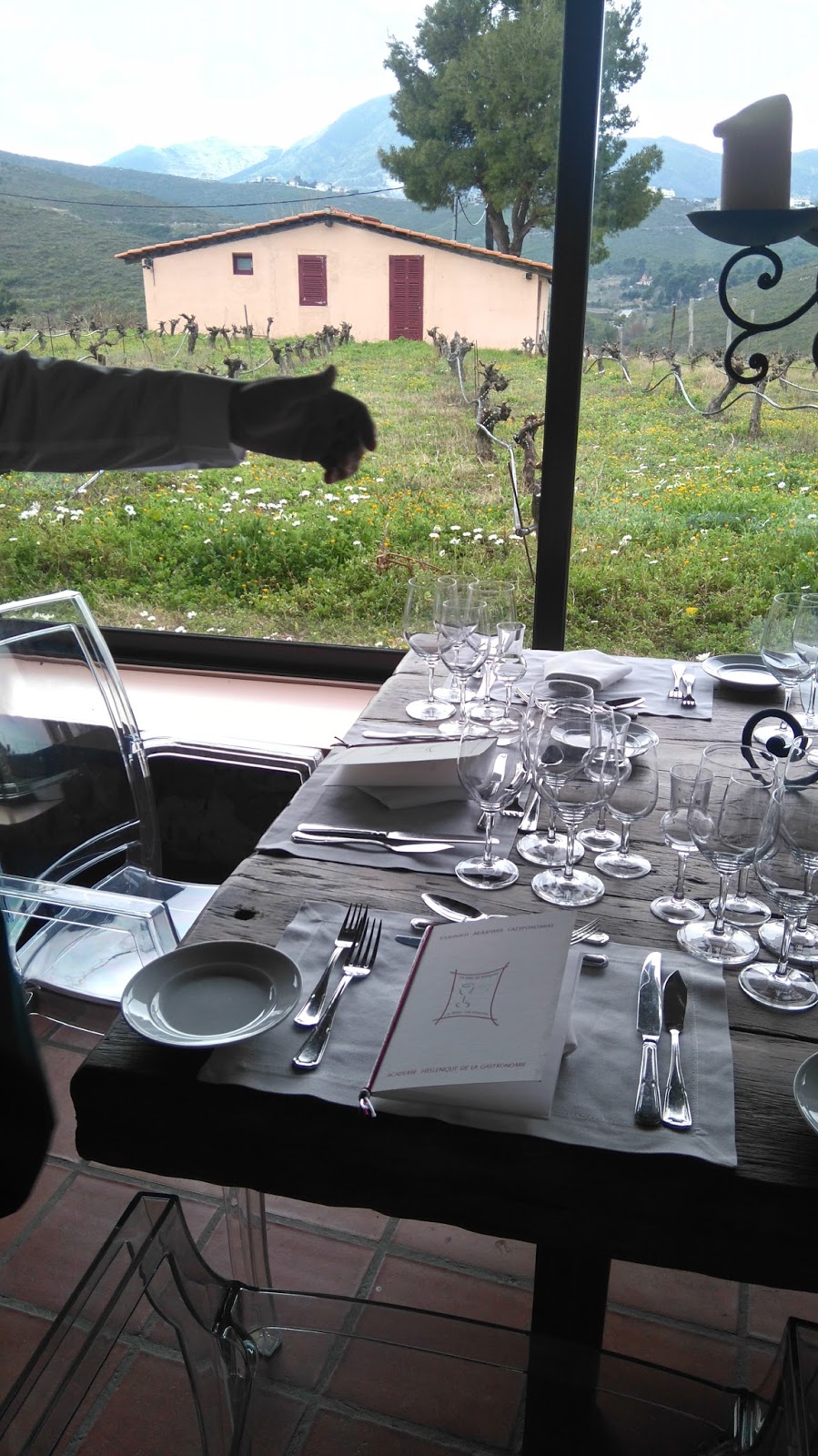
What was decided upon was a lunch on the last Sunday in February at a magnificent wine estate a short distance north from the Athens metropolitan area, the Kokotos estate (www.ktimakokotou.gr) near the village of Stamata. Apart from producing decent wines, extra virgin olive oil and honey, the estate hosts special events, wedding receptions etc. in their lovely surroundings, arguably even more stunning in late spring or summer, with nature wearing its finery. Still, even a cold wintry day could not completely eclipse the beauty of the Attic countryside and the elegant estate facilities thereon. The indoor space was also simple, elegant and set up beautifully to receive the many friends of Dionysos in style and comfort, as you can see from the photographs.

The food for the event was provided by outside caterers, with the unenviable task of matching the beauty of the surroundingson a plate, but one they managed to fulfil beautifully. Upon arrival guests
were greeted with tiny quiche Lorraine, little crispy filo pastry mushroom-filled parcels and small espresso cups of pumpkin soup with coriander. The menu proper kicked off with a gorgeous fillet of lavraki (branzino/loup de mer/european sea bass) with a lemon butter sauce and herbs, served with vegetables and tomatoes; you'll find a photograph of this somewhere. The main course was wild boar in aged red wine, oven-cooked for 12 hours and bursting with flavour, followed by a comte cheese aged for 24 months, served with a small salad and a vinaigrette using walnut oil. The dessert was chocolatey - much to my pleasure - with strawberries marinaded in brown sugar and cognac, a fitting conclusion to this splendid meal.

But of course the food would be nothing without the wines, a symphony without harmony, and what a selection we had on the day! Each wine was introduced by one of the senior Friends, together with a bit of background information on its producer and how it was tasting on the day.

I was honoured to present the first wine, a sparkler from the Jura, that isolated little part of France which is producing some great wines, as yet still reasonably priced, with style and panache. This was a Cremant du Jura BBF from Domaine Andre et Mireille Tissot, released to the drinking public only after a certain amount of time has elapsed to show at its best. It's a classy, elegant sparkler, with fine mousse and a a clean round taste, a real star of the region and a wine I would have regularly, if only I could.
The second wine was a Chardonnay from Domaine Labet, again from the Jura, Les Champs Rouges 2013. From a difficult in quantity year for the area this was a stylish mouth-filling chardonnay like a 

good burgundy white, golden-hued and round, but still with the right acidity to cut through the lemon butter sauce of the fish and enough taste to balance the combination perfectly - a success, what?
The red wine chosen to go with the wild boar, again from the Jura, was a Cotes du Jura 2005 from Domaine Jean Bourdy, made from Pinot Noir, Poulsard and Trousseau; ripe and sensuous, but not over fleshy, this was a glorious Jura red, subtle yet tasty, complex and long, old-fashioned yet perfectly modern. If this sounds like a contradiction, it's because this wonderful area is just that: a place that time forgot in some ways, yet not backward, a small idealised part of France and french winemaking before the greed turned -admittedly often great - bottles of wine into must-have objects for the world's newly enriched gangster, bankers, oligarchs or whatever. And what a joy to have a fresh, yummy 11 year old red still young in colour without having to remortgage the house...

The next wine, the only Greek wine of the day and served from a double magnum (2014 vintage), was a complete surprise to me as it came from an enterprising estate in the Pella region of northern Greece and is made from the excellent white grape variety Assyrtiko, more commonly associated with Santorini. In Pella it produces wines fuller in flavour, rounder and less minerally but still classy and distinguished. This cuvee is called Lamda, is experimental and has been aged in old oak barrels for 10-12 months to produce an intensely dry, complex, vigorous wine which was a great match for our cheese course. The  family domaine of Ligas is doing good things there in northern Greece, in the protected geographical designation of Macedonia and will soon become known to a wider audience, such is their quality and class. One unusual thing to note is that the Assyrtiko vines for this wine are not in either basket form as in Santorini or in rows like average


vineyards but, like the vinho verde vines in the north of Portugal, on trellises like climbing plants (creepers). Another oddity is that Lamda is made with skin maceration in the way of red wines; I'm told that subsequent vintages have a quite pronounced orange character. Lamda is a rarity and difficult to obtain, as only about 4,500 bottles are made every year.

The final drink of the occasion was a lovely Vieux Marc du Jura from the Domaine Philippe Butin, another tiny Jura producer who farms under 6 hectares and who continues a long family tradition of winemaking 'from father to son since 1836'. The vieux marc is essentially like aged grappa, an eau de vie (water of life, a  distillate) from the grape skins left over from wine production. Rougher that eaux de vie made from wine (e.g. cognac), it is softened by ageing in oak casks; the Jura version is clean, intense, with good fruit flavours and a kick to finish. The espresso I was served was a good companion it.

The event was rounded off with the traditional cutting of the Vassilopita, a large sponge cake type thing, with a coin hidden inside it to give luck to whoever finds it for the new year. Once again lady luck did not smile upon me, and the lucky person or persons (I think that there were two coins hidden in this enormous homemade version were at the other end of the room...


We were all given a piece of this lovely creation, nevertheless, and I took mine home to enjoy, together with a little nougat cake from the island of Sifnos, a splendid halvadopita that has no equal in my experience. From a small traditional sweet maker called Theodorou, this is a little hand-made masterpiece, where texture and taste blend harmonically and explode in your mouth, then melt gently away.

I would have loved to have just sat there drinking coffee and marc into the evening, and chatting away to all and sundry, but it was not to be. The speeches and presentations were finished, as was the marc, and people started drifting away as if they had something better to do, the fools. My companions, seized by this collective madness, pulled me away to make our way back to Athens. The last 20 years have gone quickly, but we certainly celebrated their passing in style, in a rare event for recession-hit Greece.

As we were walking back to the car I couldn't help thinking that Dionysos, looking down at us from Mount Olympus would have been well pleased with his friends - we did him proud.