Wednesday, 17 October 2018

Size isn't everything... sometimes!

Two good friends tied the knot today in a civil ceremony after many years of living together, in a move that is more about the practicalities of life than about 'cementing' their relationship. They are both in their mid-sixties and retired, so they are not about to start a family, and are not, as far as I can tell, about to go in for adoption.

For them, tying the knot was about securing their civil rights as a couple, ensuring that they could look after one another should they be hit by illness and keeping each other's pension out of the hands of the greedy state should one of them kick the bucket prematurely. Nevertheless they are in it for the long haul and their bickering is always about silly, trivial matters, never important stuff, so this was not only a practical but a happy occasion as well.

As the groom is one of my oldest friends - fifty six years and counting - I was asked to be one of the witnesses, a new experience for me and not entirely unenjoyable, especially as the lady officiating (some kind of deputy mayor, I believe) was pleasant and attractive if rather optimistic - her line about children, adopted or otherwise acquired, raised a smile from the soon-to-be newlyweds! Our small group chuckled along, then we headed downstairs to the 'garden' of the building to open our bottle of fizz, bought with no thought for cost, by yours truly.

And this is where size comes into it: despite the fact that I, as you well know dear reader, am a dedicated worshipper of Dionysos and his gifts, the newlyweds are not, so I had to find a way to mark the occasion traditionally and inject a bit of fun without wasting something yummy and precious. Then the solution presented itself  (a miniature bottle of Prosecco, the mobile phone next to it in the photograph is an old iphone 4 there for size comparison) and it was perfect - we all managed a swig each without straining ourselves in any way and yes, it was palatable - and we had a bit of a laugh at the same time. Dionysos may have been disappointed, but then again he wasn't invited.

On this occasion size didn't matter, though I am advised that this is not always the case in life.


Monday, 15 October 2018

Longevity doesn't always guarantee quality

So often we see businesses, especially restaurants, that have been around for many years and we instantly assume that, in order to last that long, they must be good at what they do. Sometimes I'm sure it's true, though you are more likely than not to be disappointed by places that once upon a time may have been good but has become simply tourist traps.

Such was my fate today when a group of hungry friends persuaded me to go to a traditional taverna in the centre of Athens, in an area that - I know, I know - is full of places aimed at the tourist trade. Nestling directly under the Acropolis is the Plaka neighbourhood with its beautiful older buildings, some impressive and imposing, others humble but picturesque. Many of these beauties are now repaired and used as houses again, but in the aftermath of WW2 and until the sixties many were neglected, abandoned or turned into commercial enterprises like bars and tavernas. With the rise of tourism in the sixties their numbers grew as well, at some point completely overrunning the area but the innocence of that era turned into the sleaziness of the seventies and the area suffered, as did its buildings.

The improving economic conditions of the late 20th century meant that people not only started appreciating beautiful older buildings but were able to afford to repair and live in them, which gave the Plaka a new lease of life. Some traditional hostelries remained, many as well-established tourist destinations where no self-respecting Athenian would be seen, others - admittedly few - stubbornly aimed at a local clientele. The place I ended up visiting today was one of the latter and for many years had remained a reliable destination for a decent traditional Greek taverna meal. I'm here to report that this is not the case today.

Platanos (plane tree) has old-world charm (having been around apparently since 1932), a pleasant-looking interior and a nice, if a bit cramped, outdoor space; it had been a haunt of the Athenian litterati in the past, but also of many ordinary folk. What we saw and all this tradition created in our group of friends expectations of a lovely Sunday afternoon's eating and drinking. Alas reality chose to intervene: the food we were served was largely indifferent and served cool, with probably the worst moussaka I have tried in recent years! Nothing was notably good, though there was a spinach pie that wasn't bad and meat dolmadhes that were about acceptable. The house wine - we tried a white and a retsina - was drinkable, sort of, but nothing more. And the multilingual menu, complete with national flags, gave the game away, as did the rather high prices.

Why has an old favourite slipped like this? Why do they choose to serve food and wine that's palatable, but barely? It's hard to know for sure without asking them, something I'm not about to do in a hurry. My theory is that it's either greed or indifference, or a combination of both, because it cannot be incompetence. If it were, how could they have gotten it right in the past?

All we can do - no, all we MUST do - as customers is to let them know of our displeasure and give them a wide berth until they improve. They MUST up their act, they MUST respect customers more! If they choose not to then they must die, at least for anyone who values quality and value for money.

P.S. : If, dear reader, you intend visiting Athens as a tourist, please do wander around the Plaka area on foot, drink in the surroundings, immerse yourself in the culture and gorge on the ancient monuments. Then go five minutes away to the centre of Athens, near Syntagma square, where there are many pleasant restaurants of all shapes and sizes that are not tourist traps. Not everyone is out there to take advantage of you, and they deserve your money more than others.


Saturday, 13 October 2018

How I suffer for my art...

Many of the world's most famous artists have, famously, suffered for their art in more ways than one, losing ears and what have you in their quest for artistic perfection. Well, dear reader. I am one of those artists, prepared to go to any lengths in the pursuit of perfection for you, for my art, for the world. High and low I will search and leave no wine bottle unopened - if I can help it, that is - in the pursuit of knowledge, which will then be brought to your door fresh, unsullied and ready to be absorbed by you to sate your quest for the best this world has to offer. Or, being realistic, whatever it is I come across that I am able to taste, absorb, describe and make known to my vast readership, should I deem it appropriate.

So when my good friend YT, he of the gastronomic adventures background and wine lover, invited me to a quiet boys only evening of Jura wines and cheeses, slightly embellished with some other bits and pieces - to ensure nobody went hungry, you understand - I just had to say yes for your sake. Not a thought did I give to my pleasure; rather, I viewed this as pure hard work: a fact-finding and reporting mission for you, dear reader, a necessary sacrifice in my ceaseless battle to ensure your sound education and happiness.

'What is a Jura?' I hear you ask in a slightly irritated tone of voice and I'm away, wearing my education hat and eager to add to your boundless knowledge:
The Jura mountains give their name to an area mainly in the southeastern corner of France but also the northwestern part of Switzerland. As expected, the area is quite mountainous - but in a verdant, rolling kind of way - and because of that relatively isolated despite being in a very central position. With a more old-fashioned agricultural way of life, quiet towns and villages, almost no heavy industry and enchanting scenery, this is a wonderful area to visit. And, as the main agricultural activity involves vines for wine making, this is an area of special interest to me and, indeed, anybody whose love and curiosity about wine is above average. That individual will be rewarded greatly by discovering and exploring the wines of the Jura region, probably far more than many better known areas - do you think that the dinosaurs of the Jurassic period who lived in the area - yes, that's where the name comes from - knew a thing or two about wine?

Let me explain why this area is special: Real wine lovers are constantly tasting, learning, searching for interesting, and often unusual, wines to get to know and enjoy. The average wine drinker, however, wants something largely familiar, reliable, available and not particularly expensive; as they hugely outnumber the first category most wine on the market is geared to them. Furthermore, the topography and weather of the Jura region does not support large-scale production, mechanisation and mass market appeal. Luckily the producers have recognised this and have stuck to their smaller scale and more individual products, though this is not to say that they shun developments in viniculture. In fact their 'normal' wines are getting increasing recognition worldwide - and, alas, commanding ever-higher prices - where their flagship Vin Jaune, that individual standard-bearer for the area had proved too difficult to get to know and love.

We kicked off our evening with a selection of salamis, some with nuts and others with cheese or spices, from the region and two wines, a white and a red, from Caveau de Bacchus, a top producer of the Arbois AOC. The white was from the 2010 vintage and Savagnin grape, oxidised but not to full Vin Jaune specification, complex and spectacular as only good wines can be with a bit of age, a bit metallic and dry, with rich, herby fruit. The red, from the Trousseau grape was a 2014 and comes more under the heading of curiosity rather than sheer pleasure - the cold weather of the area means that, despite 191 days with the skins it has a light red colour and a cherry character. The white I would happily seek out and drink again and again, assuming (a) I could find it and (b) I could afford it.

With the aperitif and nibbles out of the way we moved on to a delicious thick carrot and orange soup, followed by a fresh, crispy green salad with chanterelle mushrooms; contrasting tastes and textures alternately coating the palate and cleansing it. The Cuvee l'Hopital 2015 (another Savagnin grape wine but in the modern, fresher style without any oxidation) from Peggy and Jean Pascal Buronfosse I'm afraid I rather gulped down and remember little other than sparkling fruit, exceptional length, vivacity and complexity.

The highlight of the evening was the cheese course - three different Comte cheeses of 24, 27 and 37 months from different sources, all typical of the region but so different in character with, surprisingly for me, the middle one being freshest and having the most complex flavour, though all were just yummy. The reason that the cheese course was so special was the accompanying wines, which were of the Vin Jaune style with a strong character; one was a Cotes du Jura AOC 2001with a rustic label from the Bourdy family (just learning their craft having been making wine since 1475 or something, yes, the same family...), the other a 2000 by Philippe Vandelle from the L' Etoile AOC. Both these wines are challenging biggies bursting with flavour and too complex for words, still at the peak of their powers, young and vigorous. These are not relaxed sipping wines, not easy drinking guzzlers, but wines that deserve time and respect to be understood, occasional pleasures for the dedicated friends of Dionysos. While the L'Etoile is perhaps more ethereal and the Cotes du Jura a bit more robust, they both sang faultlessly from the same hymn sheet as the cheeses, making a uniquely satisfying melody.

The Vin Jaune wines are often compared to sherry, as they are produced using a similar method of oxidation, but I find that misleading as the taste differs significantly albeit there is a similarity in style. They are most certainly not interchangeable!

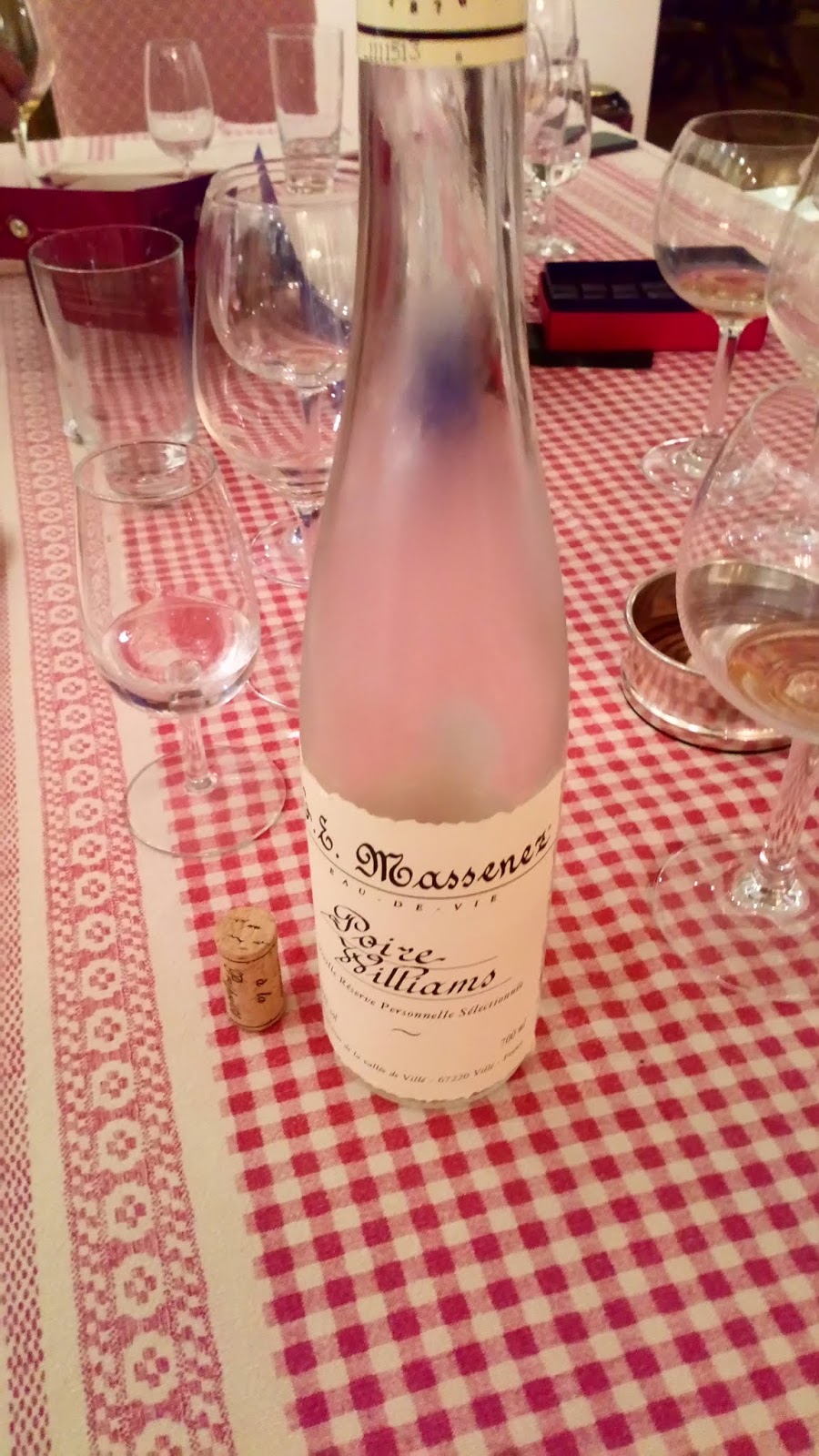
The 'keeping it simple' theme continued with the dessert course, which was different bits of chocolate (dark, of course) enhanced by a charming little drop (or two?)  of Poire Williams eau-de-vie from masterful Massenez in neighbouring Alsace to finish. If you have never had a fruit eau-de-vie from Alsace you are missing one of life's great pleasures and one far more affordable and easier to come to grips with than the Vin Jaune. After that my mind kept thinking about coffee but my body was incapable of consuming another thing.

Or was possibly completely incapable, as the blurred photograph of our table after the 'orgy', complete with Jura region tablecloth and full of empty glasses shows. At least it is shaken, not stirred...

Tuesday, 2 October 2018

Light at the end of the tunnel

Light in its many forms has always played a huge role in human affairs, starting with the sun and its effect on our life. It is so important that it has become part of our symbolisms, a positive force that combats the negative represented by darkness - light is good, darkness is bad. Night, in fact, strangles and suffocates us when we are laden with problems, whereas the morning brings light and hope.

One of the ways we use to describe this is 'light at the end of the tunnel', where our problems take the form of a dark tunnel and the potential solution (salvation?) is the light we see as we come out of it. And this expression has been used quite a lot this past summer to describe the supposed improvement in Greece's financial situation and the exit from the direct control of the infamous 'Troika' : its EU partners and lenders, the European Central Bank and the International Monetary Fund. Should we be using such an expression in this case?

Politicians have often used analogies to manipulate public opinion, make us believe in them and their ability to manage our lives and the future; this provides them with not only a purpose but a job, power or even material rewards. They clearly have a vested interest in making us feel better about life as affected by them, and to show our gratitude by voting for them.

Sometimes reality intervenes unfortunately disrupting the lovely stories, and my fear is that this is what is soon to happen this time. This is because very little has changed fundamentally for the better either in the actual Greek economy or in the attitude of the Greek people. The government has managed to 'balance the books' - perhaps 'cook the books' may be more appropriate...) in a way that satisfied some of the requirements of the supervising team and the prevailing EU political climate, but this achievement has only been possible using over-taxation and by draining the functioning economy of liquidity - a cruel form of strangulation that has left most of the private sector in ruins.

Furthermore, the attitude of the people has gotten progressively worse during this crisis, especially as the politicians have foisted more and more hardship on ordinary citizens, with tax avoidance reaching new levels and individuals, especially the young, evading any obligation possible. This has reached the form of an epidemic, with a huge number of people (my gut feeling is over 50%) paying nothing for using public transport and many encouraging shop keepers and restaurant owners not to declare transactions and asking to share the spoils. It is astounding that not only do Greek politicians refuse to learn from the mistakes of others regarding over-taxation - perhaps they should listen to Taxman, a song by the Beatles written in the sixties - but that the people also wilfully ignore their responsibility toward the state, stooping to daily theft (as described in the previous sentence), even if they do not consider it as such. Perhaps they view the State as a rich uncle who won't notice the difference or the crime as victimless. Or perhaps they see themselves as modern-day Robin Hoods taking from the rich (the bankrupt state) and giving to the needy poor (themselves).

Nevertheless the success is trumpeted, the light at the end of the tunnel is heralded; it remains to be seen whether it is the hoped for exit from darkness or a train coming the other way to flatten those in its path.


Saturday, 29 September 2018

Dionysos - my kinda guy!

My loyal reader will surely know that I am devoted to wine, its appreciation and responsible consumption; before you rush to write in remind me I will also admit to the occasional irresponsibility in my long love affair with wine. It is, you may also think, natural that I should have an interest in and affinity with the ancient god of wine and winemaking, Dionysos, though his alleged religious ecstasy and ritual madness capers I have so far left to others. Predictably, then, I would have sought to join a wine and food appreciation society with the modest name 'The Friends of Dionysos' if such a thing existed; it did and I did. For many years this has also been the Greek arm of the International Academy of Gastronomy, a bright beacon promoting quality in food and wine locally, and everything to do with Greek food and wine internationally through the auspices of the IAG.

While I am not easily convinced to respect and worship deities of any shape and size, Dionysos comes as close as any in earning my admiration - this was a god who promoted making and drinking wine, for crying out loud - and I regularly worship at his altar, figuratively speaking. My offerings may not always be to Dionysos' high standards - not that he ever had a manifesto along those lines as far as I am aware - but I can only assume that a god isn't a great fan of 'house wines'. So it was a great relief to take part in a dinner as a member of his 'Friends' featuring some quite outstanding wines that I suspect even Zeus would have been grateful to drink. Not only that, but I was asked to present a red wine from one of my favourite grape varieties (Xynomavro=sour black) from the north of Greece (Naoussa area)and a top, if major, producer, Boutari.

Let me also mention here that in recent years I have come to appreciate and support Schumacher's 'Small is Beautiful' mantra in many ways despite having written a paper decrying it at college, though my interest now is not in industrial producers but in food and/or wine and those involved in the production thereof. Usually big producers in this area tend to make industrial, less than distinguished or interesting, products that may be reliable but are often boring and lack passion, though there are rare exceptions. Boutari is one such mainstream beast, with a basic line-up of wines that are decent and even exciting; they also make a few experimental cuvees that can border on the great, even if some do not quite make the grade into regular production for whatever reason.

On a windy September evening then we kicked off with a blanc-des-noirs white wine from the north of Greece, made from the xynomavro grape (Angel's Heart 2014) and a very good producer (Tatsis in Goumenissa). Distinguished and subtle peaches featured with a layered palate, this was a gorgeous mouthful that accompanied our starter of feta, courgette and tomato tart extremely well.

'My' wine was another xynomavro wine, fully red this time, the Boutari Legacy 1879 from the excellent 2007 vintage. An experimental xynomavro wine from their Terroir No.1 - the 1879 refers to the year the Boutari company was founded, incidentally, not the vintage - that was vinified and bottled separately to Terroirs No.2 and 3. A big, tannic wine softened by bottle age, black cherry and strawberry everywhere, complex and long but perhaps lacking a bit of finesse. And I cheated and secretly tried one of the other experimental wines, Terroir 2 perhaps, which had the finesse lacking from the previous one with all the class and even more complexity. These are world-class wines deserving a wider audience and are wonderful with roast meat of almost any kind, including the pork fillet served on the night.

The wine of the evening for me, though, was the Santorini 2008 from Sigalas, served from magnums... wow! The signature Santorini white wine freshness is no longer there, but sedate maturity has given the wine a complexity and depth of taste, including mineral undertones, that is quite extraordinary. As the future of Santorini viticulture and winemaking is becoming more secure through international recognition and the higher prices these gems now command, they are, alas, becoming less affordable for the rest of us. So enjoy them where and when you can and try ageing them a bit if at all possible, even if only to see (and taste!) the difference. The Greek cheeses served with this were decent if not quite up to the majesty of the wine.

The dessert (a peach and caramel mille-feuille) was paired with an aged tsipouro distillate from the Spyropoulos family on the island of Evia (Euboea), described as a grape marc and blending almonds caramel tones with fiery alcohol for a fitting combination and an end to the meal that Dionysos himself I'm sure would have approved of. The lack of religious ecstasy and ritual madness he may have found less agreeable, which goes to show you can't please everyone, including gods of all shapes and sizes; the actual attendees seemed pretty happy, though, at another unique event hosted by his friends.

Dionysos himself must have been quite pleased also, as I had no hangover in the morning despite my extensive devotional attention to the offerings. In grateful thanks I will continue my appreciation of all wine - praise be to Dionysos and all his friends.


Monday, 24 September 2018

Make my coffee Redd, please!

Coffee is loved by millions across the globe in all its various types, hot or cold, instant or 'real', even decaffeinated. From humble beginnings in Ethiopia, Arabia and the likes, refined and 'reinvented' in Italy, it has now invaded the chicest parlours the world over. Strong, sometimes massive brands have been created on the strength of coffee's popularity over the years, dominating the market and marginalising the smaller, independent producers, until recently.
Globalisation and an increased interest in the character and quality of what we ingest has helped create a novel trend, that of 'gourmet' coffee. This is coffee made from beans bought from small independent producers, usually fully identified, and roasted in small batches according to their individual characteristics by specialists working in small or small-ish independent set-ups. These coffees do not conform to the stereotypes of taste laid down by the big boys; rather, they are complex and characterful, wildly different depending on their terroir, much like fine wine. They are different and, when they come from a top little roaster, they are good, really, really good. Suddenly your standard coffee tastes, well, ordinary.

Greece has never been thought of as a coffee pioneer, other than 'inventing' Frappe (a shaken instant coffee drink usually made with Nescafe), but there has been lots of activity on the coffee front recently, some of it very creative. One of the top little set-ups in Greece is a company called Redd Coffee, based in Athens and with a retail shop in one of the northern suburbs of said city, where they sell not only beans, but grind them to specification according to how you drink your coffee (filter and what type thereof, espresso etc.). Furthermore they can make you a coffee on the spot to drink there or take away, though they do not run a cafe per se - there is no service, few seats and no real tables. It's all about the coffee here and it's WONDERFUL!

In order to fully appreciate their coffees you must first divest yourself, dear reader, of your preconceptions about how your coffee should taste, which is not an easy thing to do, at least initially. Not only are we used to certain styles of coffee but typical roasting also tends to emphasise a house style for a type of coffee, something which is completely absent here. At the same time Italians have favoured a rather heavier roast for espresso, again with an emphasis on a general style (with 'house' undertones) and not on the individuality of the beans. Redd does the opposite, assessing and roasting depending on the beans themselves, their provenance and whether they are to be used for filter coffee, espresso or... The results are notable for their complexity, individuality and depth of flavour, making the daily cup of coffee not only enjoyable but interesting.

One thing you will not find here is coffee that is red in colour, as the name is derived from other influences (perhaps the raw beans...) and is not, as far as I can see, related to the colour of the coffee. Their premises do tend to make rather a lot of the colour, and very stylish they are too, but this is by the by as far as I'm concerned. As beautiful as the design may be, I go there for the coffee and so should you, so never forget that - so just allow your senses to open up, take in the stimuli and enjoy the various offerings, including the trendy, right-on cold brew.

The main drawback I have found since becoming a Redd aficionado is that suddenly all 'normal' coffees taste one dimensional and dull (for espresso and cappuccino), with the ordinary supermarket branded filter coffees assuming a sludgy and gritty profile. As with most everything superb quality spoils us and our tastebuds, and we yearn for more of the same; to my mind it's a price worth paying, despite the beautiful but for my taste superfluous designs made with milk (in the cappuccinos that I favour in the morning) perhaps as a result of North American stylistic influences. The other drawback is cost, which, alas, is of course higher than the more industrial counterparts but still value for money in my book And not only is every cup of coffee - or almost every, anyway - an adventure in taste but just by drinking it I am helping small coffee growers survive and thrive and not be ground down (sorry...!) by massive corporations; I'm practically a philanthropist damn it, thanks to Redd, and even you, dear reader, can become one too.


Wednesday, 19 September 2018

Of all the bars in all the world...!

There's a quirky bar on a small but popular Greek island that is my go-to place in the whole wide world when I want to chill out and relax, have a decent drink and listen to a mix of the most eclectic music possible. That it is owned by a lovely guy who has been a dear friend for the last twenty years is a bonus, not a factor, in my judgement. This special little place is on the island of Koufonissi, is called Nikita's bar and is owned and run by - you guessed it - a local man whose first name is Nikita.

Now Koufonissi is a tiny island, part of the small Cyclades grouping to the southeast of Naxos and something like four square kilometres in total - a speck in the Aegean Sea. What makes it special is that it has been blessed with beaches of incredible quality, with amazing colours and crystal-clear waters. A word of caution, though: the sea here is always a bit on the cold side, so not for lovers of warm, bathwater temperatures, due to the strong currents swirling around this little rocky place.

Nikita's Bar sits just above one such beach, probably not the most impressive around near the island's little harbour, but still better than most beaches on most other islands. Here it barely rates a mention but still forms a perfect vista as one looks across from Nikita's terrace to the uninhabited island of Keros, once a thriving centre for the Cycladic civilisation, long extinct. During the day one can ogle shapely bathers or simply relax and drink in the view, while at night depending on the quantity of moonlight available one sees a little, or a lot.

This is a 'one of a kind' place, a rarity, a bit of a gem with its own individual character and, as such, it will not appeal to everyone even though the drink and food (limited) on offer will cover most needs. The music, which I adore despite never having heard most of it before, is not 'popular'; this is not the place to hear today's pop hits or greek music of any kind. Rather, it is eclectic, sometimes jazzy, unusual, stimulating and relaxing at the same time for an old music buff like me. The lack of familiarity I find appealing rather than off-putting because the quality is so amazing.

The key to the place, other than its unique setting, is the man Nikita. From an old island family, he is a non-conformist individual, a little bundle of energy, solicitous to all if outwardly undemonstrative. In our long acquaintance I have also found him to be a kind friend, considerate and sensitive, with a touching generosity of spirit. As far as his bar goes, he is the consummate host who will look after you perfectly, but you will always be aware you are in his space.

I truly adore his little establishment. Due to my well publicised, to my faithful reader anyway, problems over the last few years I had not been to either Koufonissi or Nikita's bar for seven years and I realised on coming back that, for me, there is no substitute. It is one of my special, magical places where I can withdraw to sit and contemplate life, to relax, to heal; drink plays only a small part in this, though you can drink exceedingly well here if your taste is for beers and all sorts of spirits. This is not the place for great adventures in wine, alas for me, as the clientele for that sort of thing is sorely lacking among the visitors to the island.

It isn't perfect, I know, but it is my kind of place - please let me know if you know it, or of it. Whatever you do, though, don't spoil it.